Ends where it appeared
To look from another angle you have to formulate everything again — and writing the right question requires exactly what you do not have yet: knowing where the problem is.
Ask a question in plain English and Luminy investigates step by step until it reaches the answer, in dashboards with the exact numbers from your own database. Without opening the database to the AI, with no technician in the middle and no per-user cost.
In use at companies with more than US$ 1.4 billion in annual revenue.
“I want AI agents on my data, but I can't open the database to an AI.”
IT and legal block the project, over confidentiality, privacy law and risk.
The AI builds the queries and reads only the results, never the records. The database stays where it is.
“Every new question becomes a ticket in IT's queue.”
The ready-made dashboard can't answer the next question, and the analyst becomes the bottleneck.
People ask in plain English and get the chart with the exact numbers from your database, ready to explore.
“The AI bill keeps growing and nobody knows what was asked.”
You pay per token and per user, and usage goes unchecked.
Every query is logged. The company measures usage and watches its people ask better and better questions.
That is why asking a specialist for a report does not help, and neither does asking an AI that answers in text: both require you to already know what to look for. What works is a new way of looking, where you find out what matters while you look. See it below.
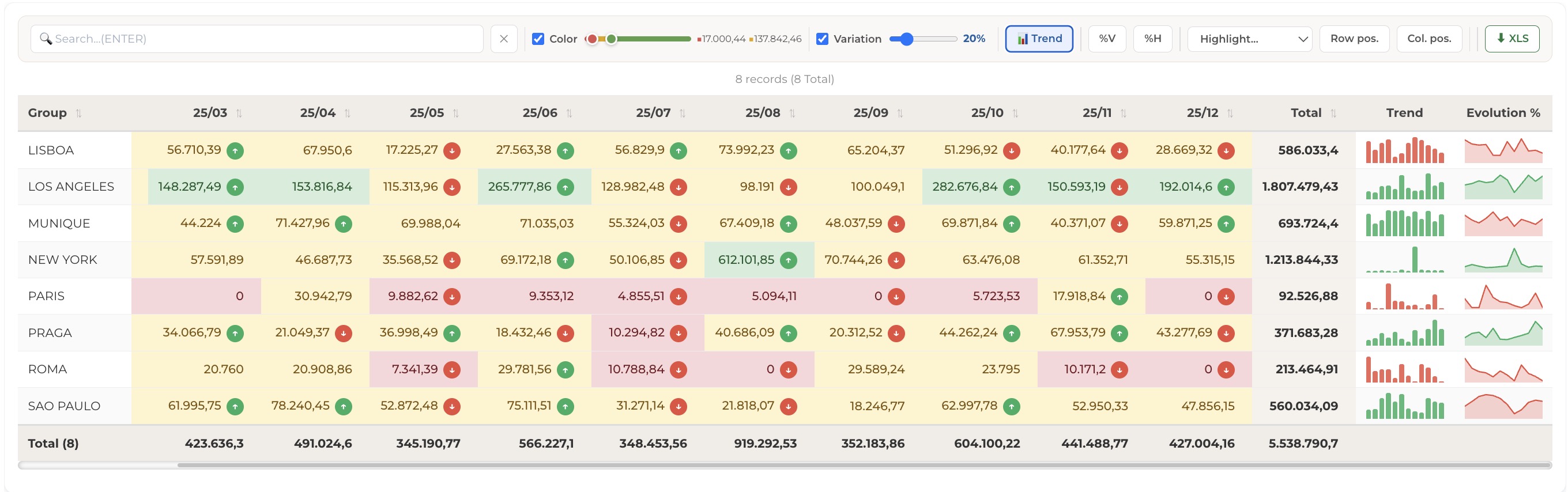
Change the fields in the question, their order and the chart type to produce a completely different result. With no technical knowledge. With no one helping you.
The difference between asking an AI and asking here is not in the answer — it is in what you can do with it once it shows up. Text you read. A chart you handle.
To look from another angle you have to formulate everything again — and writing the right question requires exactly what you do not have yet: knowing where the problem is.
Ask once. Analyse dozens of angles. And it is by handling it that you find out which angle mattered — because at the moment of asking, nobody knows.
ERPs, CRMs, operational systems and external sources.
Data is gathered, organised and prepared.
Every question becomes a report, a chart or a paragraph. And it ends there.
Runs on top of what the company already has and reads the data at the source.
Understanding stops being concentrated in a handful of specialists.
The questions that paid off become your personal library.
Library items come together into dashboards ready to consult.
You build your own query engine, entirely on your own data.
No migration, no new data warehouse, no six-month project before the first question. Luminy reads what already exists, where it already is. What changes is not the infrastructure. It is who gets to ask.
Direct connection to the databases and Data Lakes where the company already brings together the data from all its systems. No parallel copy to maintain, no new environment to provision, no queue with the data team before you start.
Tables, fields and metrics are mapped to the words people actually use. That is why “sales in 2026” finds the right answer without anyone writing a query.
The AI understands the question and builds the query, but never accesses the database or reads records. When it investigates, it sees only the query totals. Your records train no model and stay in an environment you choose, inside your company or on a dedicated server.
In Luminy, a question can also be a SQL query or JSON data, returned as a chart, ready to explore, switch views and see from other angles, like any other answer.
It is not a tool for the data team to operate on behalf of everyone else. We created different ways for each person to get the most out of the platform, according to the specific needs of each role.
In a retail chain, the people who run the stores ask the numbers directly and get the answer as a dashboard. That is how understanding spreads across the company.
The tour runs on a demo dataset and answers most questions without you talking to anyone. After that, the only conversation worth having is about your data.
The guided tour walks through a real question: from the typed sentence to the grid, the chart per row and what you can do once the answer is already there.
You will be talking to Marcus, Luminy’s founder. The conversation is about where your data lives, what can be answered in the first week and what a proof of concept would look like in your operation.